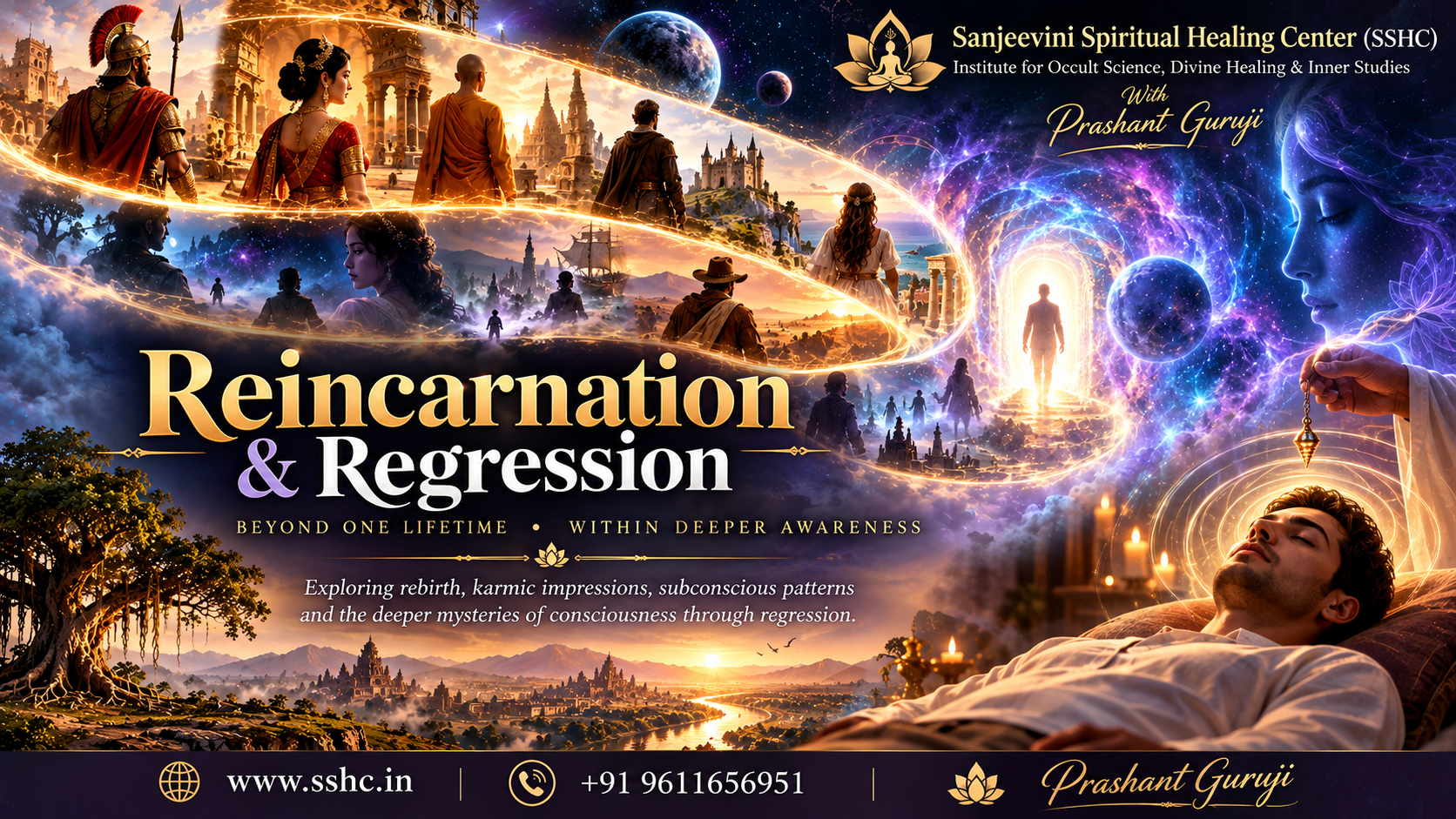
Reincarnation & Regression
A deeper exploration of rebirth, karmic impressions, subconscious patterns, regression experiences and the ancient question of whether consciousness carries a story beyond a single lifetime.
Institute for Occult Science, Divine Healing & Inner Studies
With Prashant Guruji
Reincarnation is one of humanity’s oldest spiritual questions. Long before modern regression practices appeared, Indian philosophical traditions explored rebirth, karma, samskaras, vasanas and the continuity of consciousness. Regression introduces a more experiential dimension: entering a deeply relaxed state and exploring memories, imagery, emotions or narratives that arise from within.
Does Consciousness End With One Lifetime?
Reincarnation proposes continuity across births, while regression explores experiences that some people interpret as impressions from another lifetime.
The concept of reincarnation is not simply a story about being born again. Within Indian spiritual philosophy, it is closely connected with the nature of consciousness, karma, attachment, desire, action and liberation.
The body changes. The personality changes. Circumstances change. Yet many spiritual traditions ask whether something subtler continues through these changes.
This question becomes particularly intriguing when a person encounters experiences that seem unusually familiar: recurring dreams, unexplained affinities, powerful emotional responses, spontaneous images, unusual fears or an intense connection with a person or place.
Reincarnation, Karma & Samskara
Rebirth
In many Indian traditions, life is viewed as part of a larger cycle of birth, death and rebirth. The precise philosophical explanation differs between traditions.
Karma
Karma concerns action and consequence. It is a nuanced philosophical concept, not simply a supernatural reward-and-punishment system.
Samskara
Samskaras are traditionally described as deep impressions or conditioning that influence tendencies, reactions and patterns of experience.
Vasana
Vasanas are often described as latent tendencies or inclinations that can influence desire, behaviour and repeated patterns.
Subtle Continuity
Some esoteric traditions propose that physical death does not necessarily mark the end of all subtle impressions associated with an individual stream of experience.
Liberation
In many Indian paths, the ultimate objective is not endless reincarnation or collecting past-life identities, but freedom from ignorance and karmic bondage.
The Wheel of Birth and Death
The Sanskrit concept of samsara describes the continuing cycle of conditioned existence. Within several Indian traditions, birth is not considered an isolated event but part of a much larger process shaped by action, desire, ignorance and consciousness.
The significance of reincarnation therefore goes beyond the fascinating question “Who was I before?” The deeper inquiry becomes: What patterns continue, why do they continue, and what would it mean to become free from them?
From a yogic perspective, transformation occurs through awareness. The objective is not merely to uncover hidden material, but to understand the mechanism by which unconscious impressions influence present experience.
How Reincarnation Is Understood
🕉️ Vedic & Vedantic Perspectives
Hindu philosophical traditions discuss rebirth, karma and the continuity of subtle impressions. Vedantic inquiry ultimately directs attention toward the nature of the Self and liberation rather than fascination with previous identities.
🧘 Yogic Perspective
Classical Yoga discusses samskaras, karmic impressions and the possibility of extraordinary knowledge arising through advanced concentration. The emphasis is on mastery of consciousness and liberation.
🔥 Tantric Perspectives
Various tantric traditions investigate subtle energy, consciousness, conditioning, death and transformation. Their approaches differ considerably across lineages.
🌿 Siddha Traditions
Siddha traditions explore the relationship between body, breath, consciousness, karma and spiritual transformation, presenting human existence as a multidimensional process.
☸️ Buddhist Perspectives
Buddhist traditions that teach rebirth generally approach continuity through karma and dependent arising without requiring a permanent, unchanging personal soul. This differs from some Hindu formulations.
🔬 Scientific Perspective
Reincarnation is not established as a scientific fact. Reports of apparent past-life memories have been investigated, including unusual childhood cases, but their interpretation and evidential status remain subjects of debate.
What Is Regression?
Regression refers broadly to a guided process in which attention is directed toward earlier experiences, memories, imagery or emotional material. In past-life regression, practitioners may guide a person into a deeply relaxed or focused state and invite experiences associated with an apparent previous lifetime.
The experience can be vivid. A person may encounter landscapes, people, clothing, emotions, physical sensations, names, relationships or entire narratives.
Yet vividness should not automatically be confused with historical verification. A regression experience can be personally meaningful while its literal interpretation remains uncertain.
What Draws People Toward Regression?
Different people approach regression for different spiritual, psychological or personal reasons.
Recurring Patterns
A person may explore why particular emotional or relational patterns seem to repeat despite conscious efforts to change them.
Unusual Fears
Some people investigate intense fears that appear difficult to connect with known present-life experiences, while remaining open to ordinary psychological explanations.
Relationship Themes
Powerful relationships may lead people to explore the spiritual idea of karmic connections or unfinished lessons.
Recurring Dreams
Repeated dream environments, people or narratives may become material for contemplative exploration.
Unusual Familiarity
Strong feelings of familiarity with a place, culture, language or historical setting are sometimes interpreted through a reincarnation framework.
Spiritual Curiosity
Others are simply drawn to the mystery of consciousness, death, rebirth and the possibility that human existence extends beyond one lifetime.
From Relaxation to Reflection
Preparation
The intention for the session is clarified. A useful intention is usually exploratory rather than demanding a particular answer.
Deep Relaxation
Guided relaxation can help shift attention away from ordinary external activity toward inner sensations, imagery and memories.
Inner Exploration
The practitioner may use carefully framed prompts to allow images, emotions, sensations or narratives to emerge without forcing a predetermined story.
Observation
The experience is observed with curiosity. Details are noted without immediately declaring them historically factual.
Integration
The focus returns to present life. The central question becomes what insight, meaning or pattern can be understood and integrated now.
The Most Important Question Is Not “Who Was I?”
Past-life exploration can become fascinating very quickly. A person may discover a historical setting, a name, a relationship or an emotional storyline that feels extraordinarily real.
But spiritual maturity asks a more demanding question: What does this experience reveal about the way I am living now?
If a regression experience encourages greater self-awareness, compassion, responsibility and freedom from destructive patterns, it may have meaningful personal value regardless of whether every detail can be historically verified.
Possible Themes People Associate With Past-Life Impressions
Regression Is Not the Same as Liberation
There is a subtle distinction between knowing about consciousness and being free within consciousness.
A person could theoretically remember many lifetimes and still remain governed by fear, attachment, desire and unconscious conditioning. Conversely, a person may have no vivid past-life memories and still cultivate profound awareness.
This distinction is central to many yogic and Vedantic approaches. The spiritual path is not a museum tour through previous identities. It is an investigation into the nature of the experiencer itself.
Keeping the Mystery Without Losing Discernment
Reincarnation belongs to the domain of spiritual belief and philosophical inquiry, while regression experiences belong to a complex intersection of memory, suggestion, imagination, emotion and altered attention.
A balanced approach allows both wonder and discernment to coexist.
- Explore experiences without forcing a predetermined explanation.
- Distinguish subjective experience from independently verified historical fact.
- Consider present-life psychological and environmental factors.
- Avoid allowing a regression narrative to define your entire identity.
- Use meaningful insights to improve present-life awareness and choices.
- Approach emotionally intense material with appropriate care and grounded support.
Reincarnation & Regression FAQ
What is reincarnation?
Reincarnation is the belief that some form of continuity associated with an individual continues after death and becomes associated with another birth. Different traditions explain this continuity in very different ways.
What is past-life regression?
Past-life regression is a guided experiential practice in which a person enters a deeply relaxed or focused state and explores memories, imagery, sensations or narratives that may be interpreted as belonging to another lifetime.
Does regression prove reincarnation?
No. A regression experience can feel extremely vivid and personally meaningful, but subjective vividness does not by itself establish that the experience is a historically verified memory of another incarnation.
Why do people experience apparent past-life memories?
Interpretations vary. Spiritual traditions may view them as impressions from previous lives. Psychological explanations can include imagination, suggestion, memory reconstruction, symbolism, expectation and other processes.
What is the connection between karma and reincarnation?
Many Indian traditions connect rebirth with karma, understanding actions and their consequences as part of a continuing process. Karma is a sophisticated philosophical concept and should not simply be equated with punishment.
Can regression explain unexplained fears?
Some people explore regression because they experience fears whose origins are unclear to them. A regression narrative may provide a personal framework for reflection, but it should not automatically be assumed to identify the factual cause of a fear.
Can regression reveal information about relationships?
Some practitioners interpret relationship experiences during regression through the idea of karmic connections. Such interpretations remain spiritual or personal frameworks rather than automatically verified historical facts.
Is reincarnation scientifically proven?
Reincarnation has not been established as a settled scientific fact. Researchers have investigated reports of apparent past-life memories, particularly among children, but the evidence and its interpretation remain debated.
What should someone take away from a regression experience?
The most constructive focus is often present-life integration: understanding emotions, recurring patterns, personal meaning and choices. The value of an experience does not depend entirely upon proving every detail as historical fact.
What is the deeper spiritual purpose of studying reincarnation?
In many Indian traditions, the deeper purpose is understanding karma, consciousness and the cycle of conditioned existence, ultimately moving toward greater awareness and liberation.
Related SSHC Services & Topics
Continue exploring regression, karmic patterns, energy work and spiritual healing through related areas of Sanjeevini Spiritual Healing Center.
Past Life Regression India
Explore past-life regression from spiritual, experiential and reflective perspectives.
Past Life Regression Benefits
Explore commonly described areas of personal reflection associated with regression.
Past Life Regression FAQ
Further questions about the process, experiences and interpretations.
Womb Regression
Explore regression-oriented approaches involving early developmental experiences.
Energy Healing Bangalore
Explore energetic approaches to balance, wellbeing and spiritual practice.
Reiki Healing India
Discover Reiki and its place within contemporary spiritual healing practice.
Psychic Cord Cutting
Explore energetic symbolism associated with attachment and persistent energetic bonds.
Spirit Releasement Therapy
Explore an esoteric framework concerning perceived spiritual and energetic influences.
Remote Healing Bangalore
Explore spiritual and energy-healing approaches conducted remotely.
Explore the Deeper Story of Consciousness
If you are drawn toward reincarnation, regression, karma, subconscious patterns or the mysteries of consciousness, explore the related work of Prashant Guruji and Sanjeevini Spiritual Healing Center (SSHC).
Explore Past Life Regression Contact SSHC