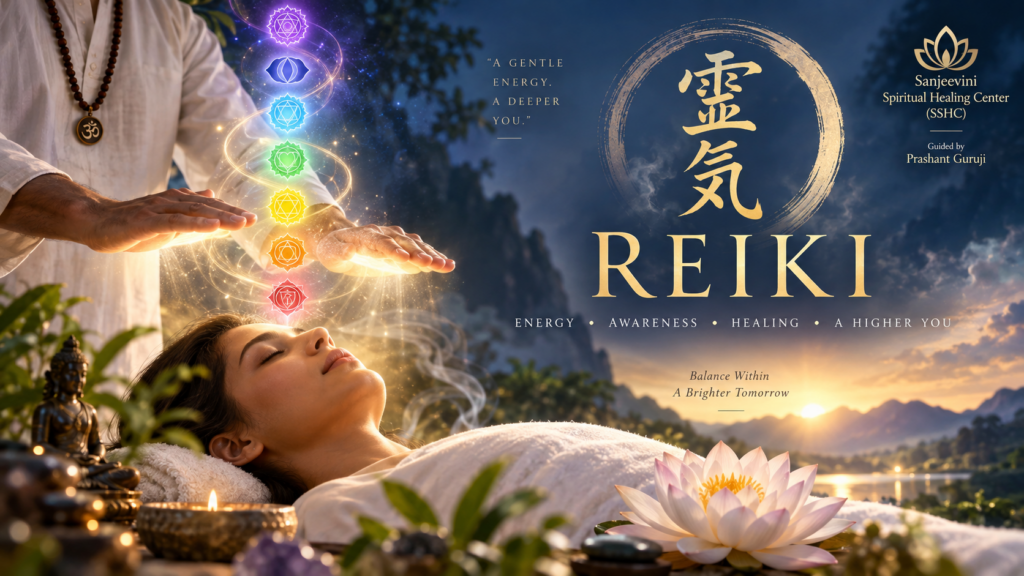
Reiki
The art of stillness, presence and subtle energy.
Explore Reiki beyond the surface of a healing technique and enter a deeper enquiry into awareness, intention, meditation and the mysterious language of energy.
When the mind becomes quiet, what begins to move within?
Reiki is often introduced as an energy-based healing practice. Yet its deeper dimension is not merely about what happens during a session. It invites a question that appears across many contemplative traditions:
Reiki emerged in Japan in the early twentieth century through teachings associated with Mikao Usui. Over time, Reiki developed into different schools and lineages, each preserving particular methods, symbols, teachings and interpretations.
At the centre of Reiki practice are themes such as presence, intention, receptivity, compassion and awareness. Depending on the tradition, practitioners may work with gentle hand positions, meditation, symbols and the traditional concept of ki, or life energy.
At Sanjeevini Spiritual Healing Center (SSHC), Reiki can be explored within a wider spiritual and holistic framework rather than being treated simply as a mechanical technique.
The visible practice of Reiki is simple. The inner exploration can be much deeper.
What Exactly Is Reiki?
Reiki can be understood differently depending on whether it is approached historically, traditionally, energetically, contemplatively or spiritually.
Rei
The Japanese term rei is commonly associated with ideas such as universal, spiritual or sacred. Translations vary, and different Reiki traditions interpret the term differently.
Ki
Ki is commonly understood as life energy or vitality. It belongs to a much wider Japanese vocabulary surrounding vitality, movement, atmosphere and life.
Presence
Reiki practice places importance on quiet attention, intention and presence. The practitioner is not simply performing a mechanical sequence.
Awareness
A deeper Reiki practice can become an exercise in noticing sensations, emotions, thoughts and subtle shifts in internal experience without immediately reacting to them.
Compassion
Compassion and ethical conduct are important themes within Reiki teachings. The practice therefore concerns not only technique, but also the quality of consciousness brought to it.
Stillness
Beneath the terminology of energy lies something remarkably simple: cultivating a quieter relationship with one’s own experience.
Mikao Usui and the Development of Reiki
The modern Reiki tradition is associated with Mikao Usui, known within Reiki traditions as Usui Sensei.
Reiki developed in Japan during the early twentieth century and was subsequently transmitted through teachers and lineages in Japan and internationally.
As Reiki travelled beyond Japan, different schools developed their own interpretations, teaching methods, symbols and practices.
Understanding this history is important because modern Reiki contains both traditional Japanese elements and later developments that emerged as Reiki spread internationally.
From Japan to the World
Reiki is no longer confined to one geographical region. It has become an internationally practiced system of spiritual, contemplative and complementary energy-oriented work.
Different Reiki lineages should therefore be studied on their own terms rather than assuming that every modern Reiki practice represents exactly the same historical method.
Reiki, Prana, Qi and the Subtle Body
Many cultures developed their own languages for describing vitality and the invisible dimensions of human experience.
These systems should not automatically be treated as identical, but interesting conceptual parallels can be observed.
In Indian yogic traditions, prana is described as vital energy and is explored through breath, awareness and subtle pathways known as nadis.
In Chinese traditions, qi refers to a fundamental concept of vitality, movement and life process.
Reiki uses the Japanese concept of ki within its own historical and spiritual framework.
The terms prana, qi and ki therefore should not simply be treated as interchangeable scientific quantities. They belong to different cultural and philosophical systems.
Prana
Yogic traditions explore prana through breath, subtle pathways, meditation and consciousness.
Qi
Chinese traditions explore qi through movement, cultivation, balance, breath and traditional energetic frameworks.
Ki
Japanese traditions use ki in a wide range of contexts, including vitality, presence and the Reiki tradition.
Reiki Is More Than Hand Positions
The visible part of Reiki is the easiest to describe. The inner dimension is more subtle.
Attention
Where attention goes, awareness follows. Reiki can provide a structured period in which attention moves away from constant external stimulation and toward present-moment experience.
Intention
Intention is important in many contemplative traditions. In Reiki, intention may be understood as an inward orientation toward compassionate practice and wellbeing.
Receptivity
Instead of constantly trying to control an experience, the practitioner may cultivate receptivity and allow awareness to observe what arises.
Silence
Silence is not merely the absence of sound. In contemplative practice, silence can become a field in which subtle mental and emotional patterns become easier to notice.
Observation
A person may notice warmth, coolness, tingling, heaviness, lightness, imagery, emotion, relaxation or simply nothing unusual.
Integration
The deeper value of a spiritual practice may not be the sensation during a session. It can be the awareness carried into ordinary life.
The Five Reiki Principles
Different Reiki lineages translate and teach the Reiki principles in slightly different ways. A commonly encountered formulation begins with the powerful phrase: “Just for today.”
Just for today, I will not be angry.
Anger can be observed rather than automatically obeyed. The principle points toward conscious response rather than unconscious reaction.
Just for today, I will not worry.
Worry can consume attention by repeatedly projecting the mind into possible futures. The teaching brings awareness back toward the present.
Just for today, I will be grateful.
Gratitude changes the direction of attention. Instead of constantly measuring what is missing, awareness begins to recognise what is already present.
Just for today, I will work honestly.
Spiritual practice is not separated from ordinary life. Integrity, responsibility and honest effort become part of the path.
Just for today, I will be kind to every living thing.
Compassion extends the practice beyond the self. The inner state cultivated during quiet practice is tested through relationship with the world.
What May Happen During Reiki?
Reiki sessions vary according to practitioner, lineage, setting and intention. There is no single universal session format.
Creating the Space
The session may begin with quiet conversation and preparation. The intention is to establish a calm environment in which the person can settle into the experience.
Settling the Attention
Relaxation, quiet breathing or meditation-oriented awareness may help shift attention away from the speed of everyday activity.
Hand Positions
Traditional Reiki sessions commonly use gentle hand positions on or above different areas of the body. Some practitioners may work without physical contact.
Observation
The recipient may notice warmth, coolness, tingling, relaxation, stillness, emotions, imagery or other subjective sensations. Another person may notice almost nothing.
Completion
The session may conclude with a period of quiet observation and a conversation about the experience.
When Energy Practice Becomes Inner Observation
Reiki can be approached as a complementary contemplative practice, particularly when the emphasis moves from sensation toward awareness.
Meditation trains the capacity to observe. Reiki can provide another setting in which the body, mind, breath, emotions and subtle subjective experience become objects of observation.
The two practices need not be confused with each other. Reiki remains a distinct Japanese-origin tradition, while meditation encompasses many different systems and methods.
Stillness
Quiet periods can create distance from continuous external stimulation and mental activity.
Awareness
Attention can become more sensitive to breathing, posture, tension, relaxation and other bodily sensations.
Observation
Thoughts and emotions can be observed without immediately turning every thought into a command.
One Practice, Many Doors of Understanding
Reiki belongs to a Japanese lineage, yet its exploration can raise questions that resonate with many contemplative systems. These parallels are conceptual, not claims that the traditions are historically identical.
Japanese Tradition
Reiki developed in Japan through teachings associated with Mikao Usui and later lineages. Ki, practice, ethical principles, meditation and compassionate presence are important themes.
Yogic Tradition
Yoga explores prana, nadis, concentration, meditation and progressive refinement of awareness. Reiki and yoga should not be treated as the same system.
Tantric Perspective
Tantric traditions explore consciousness, subtle-body symbolism, chakras, mantra and transformation of ordinary experience into a field of awareness.
Siddha Perspective
Siddha traditions contain extensive teachings concerning breath, vitality, consciousness, subtle physiology and inner transformation.
Can Reiki Work With the Chakra System?
Reiki and the chakra system originate from different historical traditions. Nevertheless, modern practitioners sometimes combine Reiki with chakra awareness because both can be explored within a broader framework of inner observation and subtle-energy practice.
In yogic and Tantric traditions, chakras are described as subtle centres associated with different dimensions of consciousness.
Reiki schools may use different approaches when discussing chakras. The two traditions should therefore be respected in their own historical contexts.
At SSHC, chakra awareness can be explored as part of the broader relationship between energy, awareness, meditation and spiritual practice.
Explore Chakra HealingThe Seven-Chakra Map
| Chakra | Traditional Themes |
|---|---|
| Root | Grounding, stability and embodiment |
| Sacral | Creativity, emotion and movement |
| Solar Plexus | Will, confidence and transformation |
| Heart | Compassion, relationship and openness |
| Throat | Expression, communication and truth |
| Ajna | Insight, attention and inner observation |
| Crown | Contemplation, transcendence and spiritual awareness |
Reiki with Prashant Guruji
Reiki is one part of the wider spiritual and complementary work explored through Sanjeevini Spiritual Healing Center.
Prashant Guruji, founder of Sanjeevini Spiritual Healing Center (SSHC), has nearly 2 decade experience across spiritual inquiry, energy-oriented practices, healing traditions, inner awareness and complementary approaches.
Within this wider framework, Reiki can be considered alongside energy work, chakra awareness, aura practices, meditation-oriented approaches, spiritual healing and other complementary modalities according to the nature of an individual enquiry.
The emphasis is not on forcing every person into the same technique. The deeper question is:
This individualized perspective allows Reiki to remain what it is: a distinct Japanese-origin practice, while also allowing it to participate in a broader spiritual journey.
Reiki in India & Worldwide
Reiki has travelled far beyond Japan and is now practiced through many schools and lineages around the world.
Reiki Is One Door
Sometimes the question that brings someone to Reiki eventually opens into a much larger exploration.
Reiki FAQ
What is Reiki?
Reiki is a Japanese-origin complementary spiritual and energy-oriented practice associated with relaxation, inner awareness, meditation and the traditional concept of ki, or life energy.
Who founded Reiki?
The modern Reiki tradition is associated with Mikao Usui, who developed and taught Reiki in Japan in the early twentieth century. Reiki subsequently developed through different teachers, schools and lineages.
What does Reiki mean?
Reiki is commonly explained through the Japanese terms rei and ki. Their interpretation varies among teachers and traditions, but they are often associated broadly with spiritual or universal aspects and life energy or vitality.
What happens during a Reiki session?
A session may begin with quiet preparation and relaxation, followed by traditional hand positions on or above different areas of the body. The exact structure varies between practitioners and Reiki lineages.
What might I experience during Reiki?
Experiences vary greatly. Some people describe warmth, coolness, tingling, relaxation, stillness, emotional awareness or imagery. Others notice little sensation. There is no single experience that a person must have.
Can Reiki be combined with meditation?
Yes. Reiki and meditation can be explored together as complementary practices for stillness, observation, relaxation and spiritual awareness.
Can Reiki be combined with chakra work?
Reiki and chakra work originate from different traditions, but modern practitioners sometimes explore them together. Within the SSHC approach, chakra awareness and Reiki may be considered complementary areas of spiritual and energy-oriented exploration.
Can Reiki be practiced remotely?
Remote Reiki is practiced within some Reiki traditions. SSHC also provides distance-oriented spiritual and energy sessions. People who cannot conveniently visit Bengaluru can enquire about whether a remote approach is appropriate.
Is Reiki a medical treatment?
SSHC presents Reiki as a complementary spiritual and energy-oriented practice, not as a substitute for qualified medical, psychiatric or psychological care. Individual experiences vary and no specific outcome is guaranteed.
Do I need to believe in Reiki before exploring it?
People approach Reiki with different beliefs and levels of familiarity. A person can begin by treating the experience as an opportunity for quiet observation, relaxation and self-awareness without needing to adopt a particular belief system immediately.
How can I enquire about Reiki with SSHC?
You can contact Sanjeevini Spiritual Healing Center and briefly explain what you would like to explore. You do not necessarily need to decide the exact modality before beginning the conversation.
Perhaps Reiki Is Not the Destination.
Perhaps it is the doorway through which you begin to listen more deeply to yourself.
If you are curious about Reiki, energy awareness, meditation, chakra work, spiritual healing or a broader holistic approach, you can begin with a simple enquiry to Sanjeevini Spiritual Healing Center.
Prashant Guruji
Founder
Sanjeevini Spiritual Healing Center (SSHC)
Rajajinagar, Bengaluru, Karnataka, India
Reiki
Explore Reiki beyond the surface of a healing technique and enter a deeper enquiry into awareness, intention, meditation and the mysterious language of energy.
When the mind becomes quiet, what begins to move within?
Reiki is often introduced as an energy healing practice, but its deeper exploration can lead into questions about attention, presence, intention, stillness and the subtle relationship between the inner and outer experience.
The modern Reiki system is associated with Mikao Usui in early twentieth-century Japan. Over time, different teachers and lineages developed their own methods of practice, teaching and interpretation.
Within Reiki practice, the Japanese concept of Ki is commonly discussed as a life-energy principle. Reiki is also approached through qualities such as presence, receptivity, compassion, awareness and disciplined attention.
Six doors into the experience
Reiki can be explored through several complementary dimensions rather than through a single definition.
Rei
The term Rei is interpreted in different ways across Reiki teachings and translations. It is often associated with a broader or universal dimension of spiritual awareness.
Ki
Ki is commonly described as life energy or vital force in Japanese traditions. The concept has parallels with other cultural ideas of vitality, although the traditions should not simply be treated as identical.
Presence
A Reiki session often begins by creating an environment where attention can slow down and become more present to bodily sensation, emotion and subtle experience.
Awareness
Instead of constantly interpreting experience, the practitioner may cultivate observation. Awareness becomes less about forcing an outcome and more about noticing what is already occurring.
Compassion
Compassion is an important dimension of many spiritual healing traditions. In Reiki practice, a compassionate attitude can create a more respectful and receptive space for inner exploration.
Stillness
Stillness does not necessarily mean the complete absence of thought. It can refer to a quieter relationship with thoughts, sensations and emotional movement.
Mikao Usui and the development of Reiki
A Japanese spiritual healing tradition
The modern Reiki tradition is associated with Mikao Usui, who lived in Japan during the late nineteenth and early twentieth centuries. Reiki developed through a combination of spiritual practice, disciplined training, healing practice and transmission through teachers.
As Reiki moved through different teachers and countries, several lineages and teaching systems emerged. Consequently, there is not always one universal interpretation of every Reiki concept, symbol or practice.
Understanding this history helps separate the original cultural context from later interpretations and modern combinations with other systems of energy work.
Reiki, Prana, Qi and Ki
Similar language, different traditions
Different cultures developed concepts describing vitality, life force or subtle energy. Indian traditions commonly use the term Prana, Chinese traditions discuss Qi, and Japanese traditions use Ki.
Do not flatten the traditions
Although these concepts can appear similar when translated into English, their philosophical backgrounds, practices and meanings are not necessarily identical. Reiki is best understood within its own historical and spiritual context.
What may Reiki actually ask of the practitioner?
Beyond technique, Reiki can become an enquiry into the quality of attention itself.
Attention
Where attention goes, experience can become more noticeable. Reiki practice can encourage a quieter, steadier relationship with attention.
Intention
Intention provides direction without necessarily demanding a particular result. A practitioner may cultivate an attitude of clarity, compassion and presence.
Receptivity
Receptivity means allowing experience to unfold rather than continuously trying to control or interpret every sensation.
Silence
A quiet environment can make subtle sensations, emotional patterns and internal movement easier to observe.
Observation
Sensations may come and go. Warmth, coolness, heaviness, lightness, relaxation or emotional movement can be noticed without assuming that every sensation has one fixed meaning.
Integration
The value of any contemplative practice is not limited to the session. Reflection and ordinary daily living remain important parts of integration.
The Five Reiki Principles
The principles are often used as a practical framework for bringing Reiki into everyday life.
Do not be angry
Just for today, I will not be angry.
Do not worry
Just for today, I will not worry.
Be grateful
Just for today, I will be grateful.
Work honestly
Just for today, I will work honestly.
Be kind
Just for today, I will be kind to every living thing.
What can a Reiki session look like?
The exact structure varies according to the practitioner, lineage and individual setting.
Creating Space
The session begins by creating a calm and respectful environment where the recipient can settle into the experience.
Settling Attention
The practitioner and recipient may take a few moments to become quieter and more attentive to the present moment.
Hand Positions
Depending on the approach, the practitioner may use established hand positions on or near different areas of the body.
Observation
Sensations, thoughts, emotions or changes in bodily awareness may arise. These experiences can simply be observed without forcing a particular interpretation.
Completion
The session concludes gradually, allowing time to return attention to the surroundings and reflect on the experience.
Reiki and meditation
Reiki and meditation can complement one another, particularly when the intention is to cultivate stillness, observation and greater awareness.
However, they are not the same practice. Meditation encompasses many different methods, including concentration, mindfulness, self-enquiry, contemplative observation and other approaches. Reiki belongs to a distinct Japanese healing and spiritual tradition.
For some practitioners, Reiki becomes a doorway into deeper silence. For others, it remains primarily a structured healing practice. Both approaches can be explored without forcing one definition onto every practitioner or lineage.
Reiki and other spiritual traditions
Modern practitioners sometimes explore Reiki alongside other contemplative systems. Historical distinctions remain important.
Japanese
Reiki originates within a Japanese cultural and spiritual environment and developed through specific teachers and lineages.
Yogic
Yoga contains extensive teachings concerning prana, concentration, meditation and subtle-body concepts. These should not automatically be treated as identical to Reiki.
Tantric
Tantric traditions may work with consciousness, mantra, subtle anatomy and transformation. Contemporary practitioners sometimes draw connections with Reiki, although the historical systems are distinct.
Siddha
Siddha traditions contain sophisticated approaches to body, breath, consciousness and spiritual transformation. Their concepts should be studied within their own lineage rather than reduced to modern energy-healing terminology.
Reiki and the Chakra System
Chakras belong to several Indian spiritual and yogic traditions and have been interpreted in different ways across historical texts and modern schools. Reiki itself is not identical to the chakra system.
Modern Reiki practitioners sometimes combine Reiki with chakra-focused meditation or energy work. Such combinations are contemporary practice choices rather than evidence that the two traditions originated as one system.
| Chakra | Common Modern Association | Contemplative Area |
|---|---|---|
| Root | Grounding and stability | Connection with physical presence |
| Sacral | Creativity and emotional flow | Relationship with feeling and movement |
| Solar Plexus | Personal power and confidence | Will, action and self-direction |
| Heart | Compassion and connection | Emotional openness and kindness |
| Throat | Communication and expression | Truthful and conscious expression |
| Ajna | Insight and inner observation | Attention, perception and contemplation |
| Crown | Spiritual awareness | Contemplation and transcendence |
Reiki at Sanjeevini Spiritual Healing Center
Prashant Guruji
At Sanjeevini Spiritual Healing Center (SSHC), Reiki is explored within a broader spiritual and complementary framework rather than being reduced to a single technique.
Under the guidance of Prashant Guruji, with nearly 2 decade experience in spiritual and complementary healing work, the focus is on creating a respectful space for inner exploration, awareness and individual experience.
Reiki may be explored alongside meditation, energy work, chakra-focused practices and other spiritual approaches according to the nature of the enquiry.
Every individual experience is different. Sensations or emotional responses during a session should not automatically be interpreted as proof of a particular physical, psychological or spiritual condition.
Reiki Healing in India and Worldwide
Reiki enquiries can be explored through SSHC services for people in different locations.
Other pathways you may wish to explore
Reiki FAQ
What is Reiki?
Reiki is a Japanese spiritual and complementary practice associated with gentle touch or hands placed near the body, attention, presence and the concept of subtle energy.
Who founded Reiki?
The modern Reiki system is associated with Mikao Usui in early twentieth-century Japan. Different lineages subsequently developed their own teaching systems and methods.
What does Reiki mean?
Reiki is commonly discussed through the Japanese terms Rei and Ki. Interpretations vary across translations and lineages, so the terms are best understood within their particular teaching context.
What happens during a Reiki session?
A Reiki session generally creates a quiet setting in which the practitioner and recipient settle attention, use established hand positions or hands near the body, and observe sensations and responses.
What might I experience during Reiki?
Experiences vary considerably. Some people describe relaxation, warmth, coolness, heaviness, lightness, emotional movement or simply quietness. Others may notice little or nothing unusual. There is no single required experience.
Can Reiki be combined with meditation?
Reiki and meditation can be explored together as complementary contemplative practices. They remain distinct traditions with different histories and methods.
Can Reiki be combined with chakra work?
Some modern practitioners combine Reiki with chakra-focused practices. Such combinations are contemporary approaches and should not be assumed to represent the historical origins of Reiki.
Can Reiki be practiced remotely?
Some Reiki practitioners offer distance or remote sessions. These practices are understood within particular Reiki lineages. Distance Reiki should be approached as a complementary spiritual practice rather than a replacement for professional medical care.
Is Reiki a medical treatment?
Reiki should not be used as a substitute for diagnosis or treatment from a qualified medical or mental-health professional. People with health concerns should continue appropriate professional care.
Do I need to believe in Reiki before exploring it?
A person does not necessarily need to begin with a fixed belief. Reiki can be approached as an experiential and contemplative practice, while maintaining an open but discerning attitude toward individual experiences and interpretations.
How can I enquire about Reiki with SSHC?
You can contact Sanjeevini Spiritual Healing Center through WhatsApp or phone at +91 9611656951 to enquire about Reiki and related SSHC services.
Perhaps Reiki Is Not the Destination.
Perhaps it is the doorway through which you begin to listen more deeply to yourself.
Prashant Guruji
Founder, Sanjeevini Spiritual Healing Center (SSHC)
Rajajinagar, Bengaluru, Karnataka, India